
A restaurant security camera system in Chicago does a narrow, useful job: it records the doors, the registers, the bar, storage and the delivery entrance, so an owner can answer what happened at the till on Tuesday night or who signed for the produce. The system planned here is wired, recorded on a box in the restaurant's own locked closet, and set up with the audio turned off from the first day.
Last updated: November 2026
Camera positions in a Chicago dining room
- Entrances: the front door and the alley or delivery door, framed to catch a face at the threshold.
- Registers and the bar: the cash drawer and the counter, angled from above and behind the staff side.
- Back of house: dry storage, the liquor room and the walk-in door.
- Office: the safe and the deposit table.
- Outside: the dumpster area and the parking lot where the lease allows it.
Some places never get a camera: restrooms, changing areas and any staff locker space. A register camera is aimed so it never records a guest or an employee entering a PIN on the card reader. Those lines are drawn on the plan before a single bracket goes up.
Why the microphones stay off in Illinois
Most IP cameras ship with a microphone, and many turn it on by default. Illinois has a strict eavesdropping statute. Section 14-2(a)(1) of the Illinois Criminal Code says a person commits eavesdropping when he or she knowingly and intentionally uses an eavesdropping device, in a surreptitious manner, to overhear or record all or any part of a private conversation to which he or she is not a party, unless he or she does so with the consent of all of the parties to the private conversation. A dining room is full of private conversations. So audio is switched off in each camera, and in the recorder, and the setting is listed in the handover file.
Cabling, recording and the network
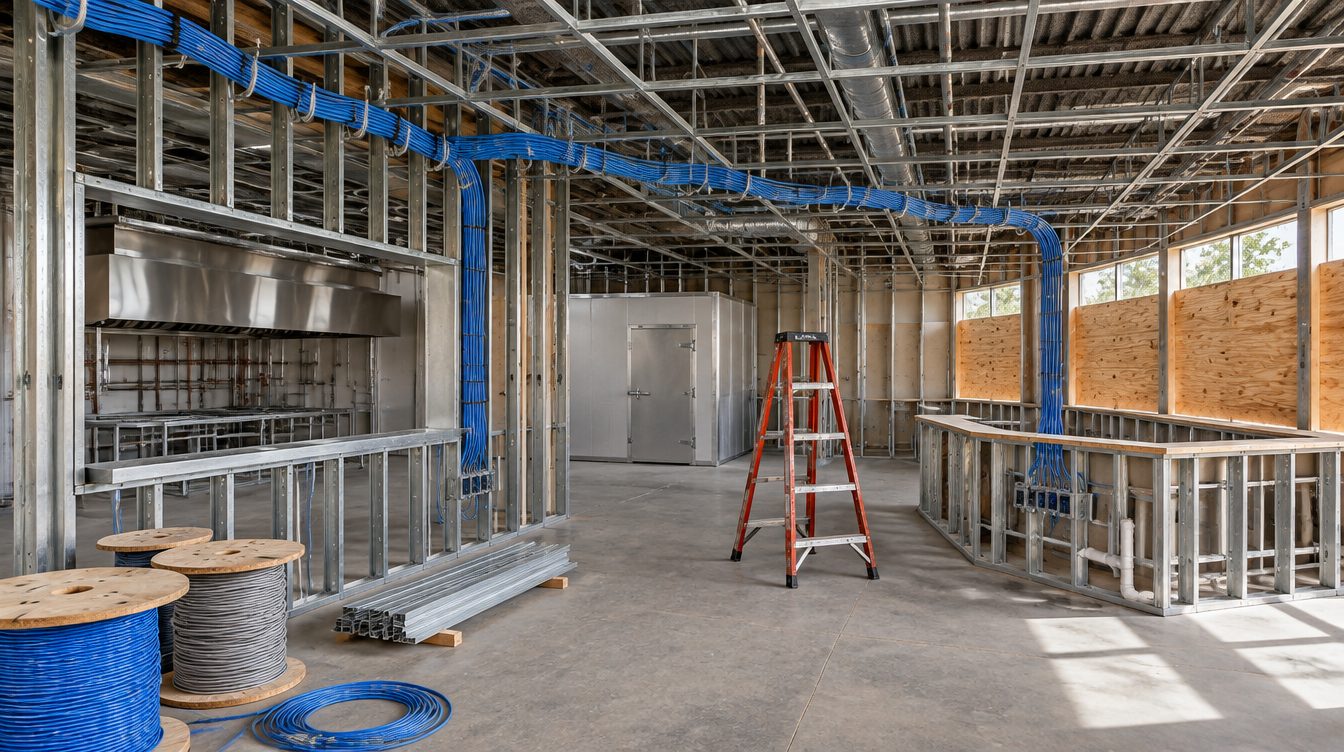
Each camera gets its own cable, pulled with the rest of the low voltage wiring, back to the switch in the closet, which powers the camera over that same run, so there is no outlet to mount near the ceiling. The recorder sits in the closet on the battery backup, with enough storage for the retention period the owner picks. Cameras live on their own network, apart from the payment lane and guest WiFi, so a low-end camera's firmware never has a path to a card reader.
Viewing from a phone goes through the recorder vendor's app, set up on the owner's own account. Every admin password is changed from the factory default and given to the owner at handover. The restaurant owns the system and its footage.
Cameras and the doors
Cameras pair naturally with readers on the alley door and the liquor room, so a badge event has a picture beside it. The door hardware itself follows the exit rules laid out on the home page. A camera never changes how a door locks or releases.
If footage or a recorder ever went missing
A camera recorder can hold more than video once it sits on the same network as the registers, which is one more reason it gets its own lane. Illinois sets a breach rule for computerized data that holds personal information. Section 530/10(a) says the disclosure notification shall be made in the most expedient time possible and without unreasonable delay, consistent with any measures necessary to determine the scope of the breach and restore the reasonable integrity, security, and confidentiality of the data system. The statute names no fixed day count. What the camera build adds is a separate network and logs that make the scope of any incident readable.
Signs, staff and the employee handbook
Many operators post a visible notice that the premises are under video recording and add a camera line to the staff handbook. What the notice says, and how footage is used in a staff matter, is a question for the owner's own employment counsel; the install simply delivers cameras where the plan says, with the microphones off.
What the owner receives
- A camera map showing each position and what it frames.
- The recorder's admin login, the app account and the retention setting.
- Labels on each camera cable matching the port map.
- A note confirming audio is disabled on every camera and on the recorder.
Restaurant camera questions
How many cameras does a small restaurant need?
The count comes from the doors, registers and storage rooms on the plan, not a package size. A counter-service storefront often needs far fewer than a two-floor dining room with a bar.
Can cameras already on the wall be reused?
If they work and can join a separate network, yes; list them on the project form. Anything that cannot have its password changed or its audio disabled is replaced.
Who watches the cameras?
Nobody from this site watches live video. The restaurant owns the system and its footage, and viewing runs through the owner's own account.